
Pilates grip socks that stay put on the reformer, the mat and the barre
A non-slip sole under the whole foot, a ribbed cuff that stays up, and three cuts to choose from. One size, 13 colors, sold by the pair or in packs of 3 and 6.

Why a bare foot slides in class and a grip sock stays put
If you have ever done footwork on a reformer in ordinary socks, you know the feeling. The carriage moves, the footbar is padded and slightly slick, and your heel creeps down the bar every few reps. You stop thinking about your hips and start thinking about your feet. The same thing happens on a mat in a lunge, and on a wood floor at the barre in a relevé. The floor is not the problem. The sock is.
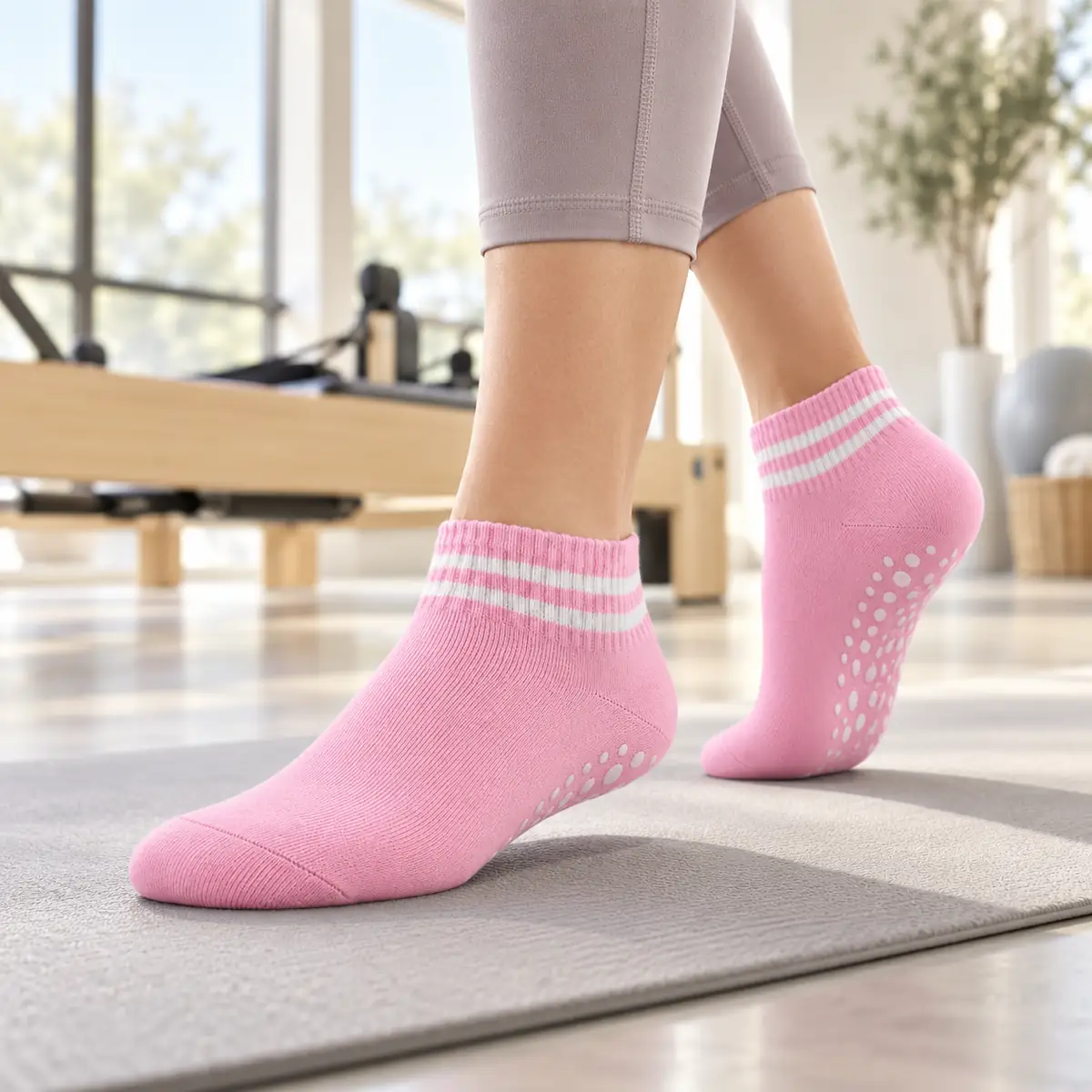
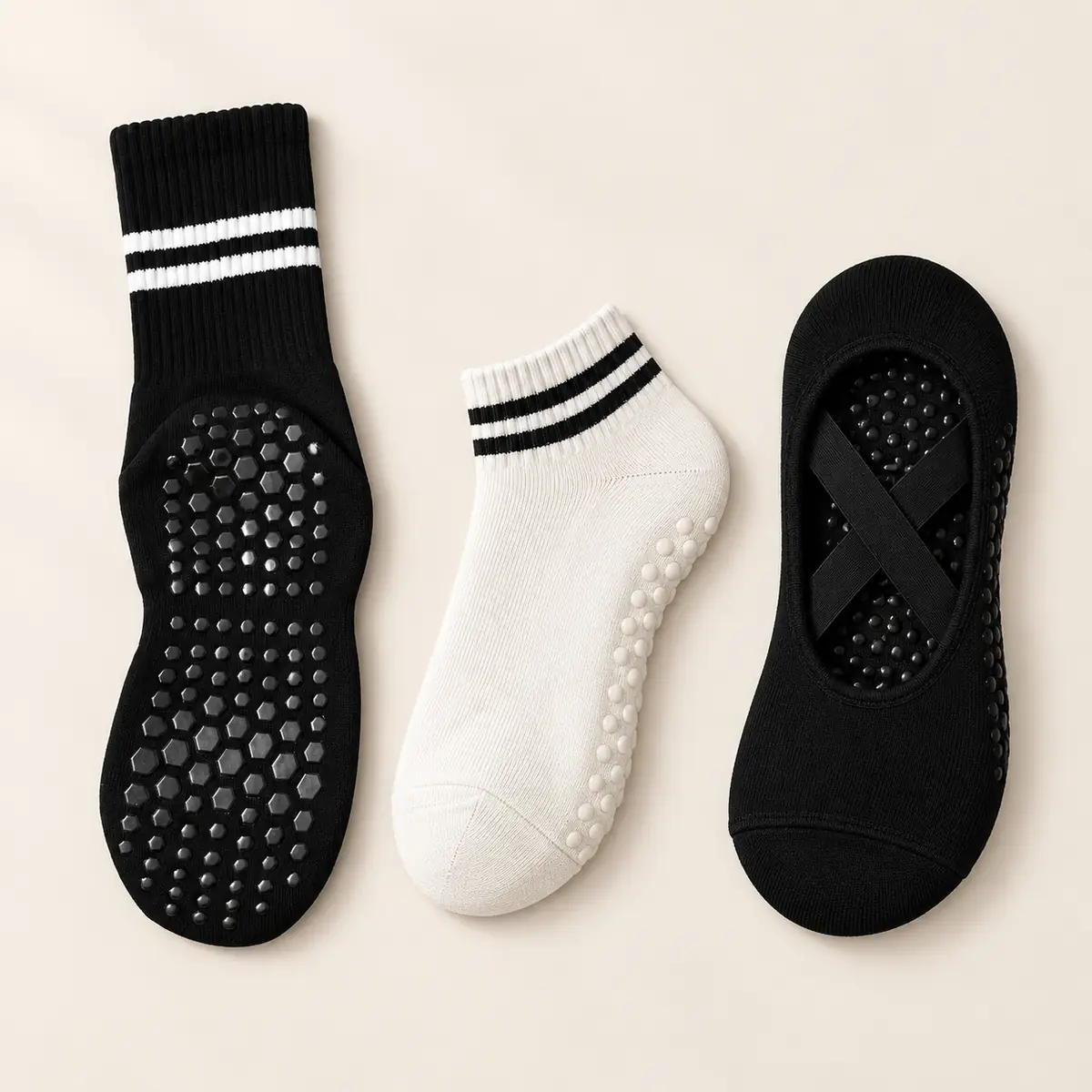
A Pilates grip sock solves this with one detail: a pattern of silicone or rubber under the sole. On our crew style that pattern is a honeycomb that covers the whole sole, heel to toe. On the ankle style it is a rubber sole the spec sheet describes as silenced and non-slip, over a cushioned bottom. On the ballet style it is a non-slip sole under a slipper-shaped upper with cross straps, toes and heel covered. In all three cases the idea is the same. The foot stays where you put it, so you can press into the bar, hold a plank or balance on one leg without your foot sliding away.

Buyers describe it in plain words. They say the socks don't slip on wood floors, that the grips do their job, that the fit is snug. That is the whole point, and it is why many reformer studios ask for grip socks in class. Shared equipment gets wiped down between classes, and a sock between your skin and the carriage is part of studio etiquette as much as it is a matter of footing. Our guide on whether you need grip socks for Pilates goes through the studio rules class by class.
The second detail is the cuff. A grip sock that slides down inside a strap or bunches under the heel is as distracting as a sock that slips. The crew has a high-elasticity ribbed cuff that sits mid-calf. The ankle has a ribbed double-loop cuff that sits low. The ballet holds with straps across the top of the foot. Which one you want depends on the class, and that is what the rest of this page is for. If you already know you want the closed-toe, low-cut pair that most reformer studios expect, go straight to our non-slip Pilates socks page.
Three details that decide whether a Pilates sock stays put
Every grip sock looks the same in a photo: a knit sock with a pattern underneath. The difference shows up twenty minutes into a class, when the heel has either stayed on the footbar or crept off it, and the cuff has either stayed up or rolled into a ring under the ankle. These are the three details we look for in a pair before it goes on this site.
A non-slip sole under the whole foot
The grip covers the sole, not just the ball of the foot.
On the crew the honeycomb silicone runs heel to toe. Heel coverage matters more than it sounds: in footwork on the reformer your heels are on the bar, and in a bridge or a roll-down they are on the mat. A sole with grip only under the forefoot lets the heel slide first. The ankle uses a rubber non-slip sole over a cushioned bottom, and the ballet a non-slip sole under a covered-toe upper with an open instep. In all three cases the pattern is the reason buyers say the socks don't slide.

A cuff that stays up
Ribbed, elastic, and shaped to stay where you pulled it.
The crew has a high-elasticity ribbed cuff and a knit that wraps the arch of the foot, so the sock stays snug through a class rather than working its way down. The ankle has a double-loop ribbed cuff that sits just above the shoe line, and a hand-sewn flat toe seam, so there is no ridge across the toes when your foot is in a strap. The knit on both is a cotton and polyester blend, which is why buyers describe them as soft rather than plasticky.

Three cuts for three kinds of class
Crew, ankle or ballet, one size, each in its own colors.
The crew sits mid-calf and is the warm, covered option for floor work and barre. The ankle stops at the ankle bone and is the low-profile option most reformer studios have in mind. The ballet is a slipper-style sock with cross straps over the top of the foot: the toes and the heel are covered, the instep is open, and the sole still holds. Each style has its own colors, five for the crew, five for the ankle and three for the ballet, and any pack mixes colors within one style. Our ballet grip socks page covers the open-instep cut in detail.

Which style for which class: an instructor's decision matrix
There is no single best Pilates sock, because a mat class, a reformer class and a barre class ask different things of your feet. This matrix is how Elise Hartley, who teaches mat and reformer, matches the three PIVELYA styles to the class on the schedule. It is a recommendation from teaching and from wearing the socks, not a measurement. Start with the class you take most often and buy that style first. If you split your week between formats, the 3-pair pack in one style is the simplest way to cover it. The reformer Pilates socks page explains the reformer case in more detail, and the barre socks guide does the same for the barre.
| Class | Style we suggest | Why |
|---|---|---|
| Reformer: footwork, straps, standing work on the carriage | Ankle first, ballet second | The low cut stays clear of the straps and the rubber sole holds on the carriage and the footbar. Ballet if you want less fabric over the foot, with straps that hold the sock on a pointed foot. |
| Mat Pilates, on a mat or a wood floor | Crew | Heel-to-toe honeycomb grip for planks, lunges and roll-downs. The mid-calf cuff keeps the lower leg warm on the floor. |
| Barre | Ankle or crew | Relevés and pliés on a smooth floor need grip under the heel as much as the ball of the foot. The ankle is the usual barre choice, nothing above the ankle bone; the crew cuff stays up through a long series when the studio runs cold. |
| Tower, chair and Cadillac | Ballet | The cross straps keep the sole seated as the foot points and flexes on the pedal and the bar, and the sole still holds on the wood and the padding. |
| At home, on wood or tile | Crew or ankle | Without a mat the sole does the mat's job. Crew for a cold floor, ankle for a warm room. |
| Heated or hot studio | Ballet or ankle | The least fabric on the foot. The open instep and the low cut keep the foot cooler between sets. |
| First month of classes | Ankle | The cut most studios expect at the door, and the one that works in every class on the schedule while you decide what you like. |

Pilates by the numbers
in a row that Pilates has been the most booked workout worldwide
— ClassPass 2025 Look Back Report, 2025
Pilates reservations made on ClassPass in 2025
— ClassPass 2025 Look Back Report, 2025
Americans took part in at least one sport, fitness or leisure activity in 2025
Fuller studios mean more shared carriages, more dress codes that ask for grip socks, and more people buying their first pair without knowing which cut to pick. The matrix above and the comparison below are written for that first pair.
The three PIVELYA styles side by side
| Style | Cut | Classes we suggest | Colors | Fabric and sole |
|---|---|---|---|---|
| Crew | Mid-calf, high-elasticity ribbed cuff, two stripes | Mat, barre, at home | Black, White, Pink, Blue Gray, Purple | Cotton and polyester knit. Full-sole honeycomb silicone grip. |
| Ankle | Low cut at the ankle, double-loop ribbed cuff, hand-sewn flat toe seam | Reformer, barre, first month | Black, Off-white, Gray, Pink, Purple | Polyester and cotton knit. Rubber non-slip sole, cushioned bottom, breathable. |
| Ballet | Slipper cut, covered toes, open instep, cross straps over the foot | Tower and chair, hot studios, yoga | Black, Gray, Pink | Polyester knit. Non-slip sole. 8.3 in by 3.1 in laid flat, the maker's dimensions. |
Packs work the same way for every style. A single pair is one style in one color. A 3-pair pack is one style in any three of its colors, and a 6-pair pack is one style in any six, so a crew pack can be black, white and pink while an ankle pack is black, gray and purple. You choose the color of each pair in the box at the top of this page, and the box shows the price per pair for each pack. Two styles in one order are simply two lines in the cart.
All three styles are one size and every pack is one style with any mix of that style's colors, so the choice comes down to cut. Pick by the class you take most. The ankle is the safe first pair: it is what a reformer studio means when it says grip socks, and it disappears inside a strap. The crew is the pair you reach for on a cold floor and at the barre. The ballet is the pair for anyone who wants the least fabric on the foot, with straps that hold the sock on through a relevé. Pilates has been the most booked workout on ClassPass for three years running, according to its 2025 Look Back Report, and the schedules that come with that growth mix formats: a reformer class on Monday, a mat class on Wednesday, barre on Saturday. Two styles in the drawer cover a week like that. If you are weighing these against a yoga sock, our guide to yoga socks vs Pilates socks sets out what changes between the two.

A grip sock has one job: keep the foot where you put it. On a reformer the carriage moves and your foot should not. Look at the sole first, the cuff second and the color last.— Elise Hartley, Pilates instructor, mat and reformer since 2017
How to choose Pilates grip socks
Buying guide: grip pattern, cuff, fabric and care
Start with the sole
Turn the sock over before you look at anything else. What you want is a pattern that reaches the heel and the outer edge of the foot, not a patch under the ball. In footwork, in a bridge and in a roll-down the heel carries the load, and a sole that only grips at the front lets the heel go first. Honeycomb silicone, as on our crew, spreads the contact over the whole sole. A rubber sole, as on our ankle, does the same with a quieter feel on a wood floor; the maker calls that sole silenced. Either way, the pattern is what buyers are describing when they say the socks stay put.
Then the cut
The cut decides where the sock ends and what it touches. A crew ends mid-calf and stays warm; it is the pair for floor work, for the barre and for a cold studio. An ankle ends at the ankle bone and stays out of the way of straps and footbars; it is the pair most reformer studios have in mind. A ballet covers the toes and the heel, leaves the instep open and holds with cross straps; it is the pair for anyone who wants the least fabric on the foot on the pedal of a chair or on a mat in yoga. If you take one format only, buy that cut. If you take two, buy the cut for the class you take most and add the second later.

Then the fabric
The crew and the ankle are knit from cotton and polyester, which is why buyers call them soft and dense rather than plasticky. The ballet is a polyester knit with an open instep, which suits a warm studio. All three are one size. The knit stretches, and the fit is snug by design: a loose grip sock slides inside itself and the pattern never reaches the floor. The ballet measures 8.3 in long by 3.1 in wide laid flat, the maker's dimensions. Our best Pilates socks guide goes through grip, cut and fabric with the same criteria, and how we test explains what we check on each pair.
Care: our recommendation
Grip patterns lose their hold from heat and residue, not from classes. Our recommendation is a cool machine wash with the socks turned inside out, no fabric softener, and air drying flat. A hot dryer flattens the pattern; softener coats it. Rotate two or three pairs through the week and each one sees fewer washes. The full routine is in how to wash Pilates socks.

For studios
Studios that keep pairs at the front desk order the 6-pair pack in one style, usually the ankle in black, so that any client who arrives without socks can take a class. A basket of assorted colors sells through faster than a single color. Our Pilates socks for studios page covers packs, colors and reordering.

Specifications
| Styles | Crew, Ankle, Ballet |
|---|---|
| Crew | Mid-calf. High-elasticity ribbed cuff, two stripes. Cotton and polyester knit. Full-sole honeycomb silicone grip. |
| Ankle | Low cut at the ankle. Double-loop ribbed cuff, hand-sewn flat toe seam. Polyester and cotton knit. Rubber non-slip sole, cushioned bottom. |
| Ballet | Slipper cut, covered toes, open instep, cross straps over the foot. Polyester knit. Non-slip sole. |
| Size | One size, all three styles |
| Ballet dimensions | 8.3 in (21 cm) long by 3.1 in (8 cm) wide, laid flat |
| Colors | Crew: Black, White, Pink, Blue Gray, Purple. Ankle: Black, Off-white, Gray, Pink, Purple. Ballet: Black, Gray, Pink. 13 in total. |
| Packs | 1 pair, 3 pairs or 6 pairs. One style per pack, any mix of that style's colors. |
| Care | Our recommendation: cool wash inside out, no fabric softener, air dry flat |
Fabric, sole and dimensions are the spec sheet's published descriptions for each style. Care instructions are our recommendation.
Rated 4.9 / 5 on 1,410 verified ratings, with 36 written reviews published
The words that come back most often are don't slip, comfortable, soft and snug. Three verbatims below, one per style. Every written review, with the photos buyers sent, is on our reviews page.
"They are great for pilates and barre. You don't slip and they have good grip."
— Elise M., verified buyer
"Fast delivery. Exactly as described. Excellent condition. Good color selections and good fitting. Comfortable grip socks great for yoga or pilates classes. I would buy more next time."
— Daniel L., verified buyer
"I am in love with these socks, they are comfortable and fit perfectly to the foot, and the silicone dots on the sole keep the foot firmly on the ground in a comfortable way because it has a low profile. And the colors are beautiful."
— Bianca F., verified buyer
Buyer photos and every written review are on our reviews page.

Elise Hartley · Pilates instructor · mat & reformer since 2017
Elise teaches mat and reformer Pilates and has worn and compared more than 40 pairs of grip socks on wood floors, reformer carriages and rubber mats since 2017. She writes every guide on this site and checks each product claim against the spec sheet's own data.
Reviewed and updated September 9, 2026. See how we test and who we are.
Pilates socks: the questions we get asked
These are the questions people type into a search box before buying a first pair, answered from the studio floor. Each answer is short on purpose. Where a question deserves a full guide, the link is in the section above.
Do I really need grip socks for Pilates?
On a reformer, yes. Most studios ask for grip socks because the carriage, the footbar and the straps are smooth, and a bare or plain-socked foot slides on them. On a mat they are optional, but they keep the foot from sliding in planks and lunges and keep your feet warm on a cold floor. Many studios also list them in their dress code.
Why are grippy socks used in Pilates?
Because the surfaces in a Pilates studio are smooth on purpose. Wood floors, vinyl carriages and padded footbars are easy to clean and easy to slide on. The silicone or rubber pattern under a grip sock gives the foot something to hold, so the effort goes into the exercise instead of into keeping your footing. Studios also prefer socks to bare feet on shared equipment.
What socks are best for Pilates?
The best Pilates sock is the one whose grip covers the sole, whose cuff stays up and whose cut matches your class. We judge by those criteria, not by a logo. For reformer footwork we suggest the crew or the ankle, for barre the ankle, and for mat work where you want less fabric on the foot, the ballet. All three have a non-slip sole.
What are Pilates socks good for?
Three things. They keep the foot from sliding on a smooth floor, a reformer carriage or a footbar. They keep feet warm in a studio that runs cool. And they keep your skin off shared equipment, which is why many studios require them. Beyond Pilates, buyers wear them for barre, yoga, workouts at home and simply around the house on wood or tile floors.
What is the difference between yoga socks and Pilates socks?
Very little in construction: both use a non-slip sole. The difference is the use. Yoga socks are often cut without a toe cap or with separated toes so the toes can spread on a mat. Pilates socks are more often closed-toe, with a cuff that stays up while your feet are in straps or on a footbar. Our ballet style, with covered toes and an open instep, sits between the two and works for both classes.
Why do Pilates socks lose their grip?
Heat and residue. A hot dryer softens and flattens the silicone or rubber pattern, and fabric softener leaves a film on it that stops it from holding. Sweat and floor dust do the same over weeks of classes. Our recommendation is a cool wash inside out, no softener, and air drying flat. Rotating between two or three pairs also spreads the wear.
Are the socks one size, and can men wear them?
All three styles come in one size, with a knit that stretches. The ballet measures 8.3 in long by 3.1 in wide laid flat, which are the maker's stated dimensions. Buyers describe the fit as snug. The crew is described as unisex; the ankle and the ballet are sold in the women's range. If in doubt, start with one pair and use the 30-day money-back guarantee.
Can I wear Pilates grip socks for barre, yoga or workouts at home?
Yes. A barre class asks for the same thing as a reformer: a foot that holds in a relevé and a plié on a smooth floor. Yoga on a mat works with the ballet, which has the least fabric over the foot. At home, on wood or tile, a crew or ankle pair keeps a plank or a lunge from sliding without a mat. Buyers also wear them for weighted squats.
Pick a style, pick your colors
One size, 13 colors, packs of 1, 3 or 6 pairs. Free shipping and a 30-day money-back guarantee.
Shop socks →⏳ Stock is running low